


A 27B open-weight LLM adapted for Korean character conversation
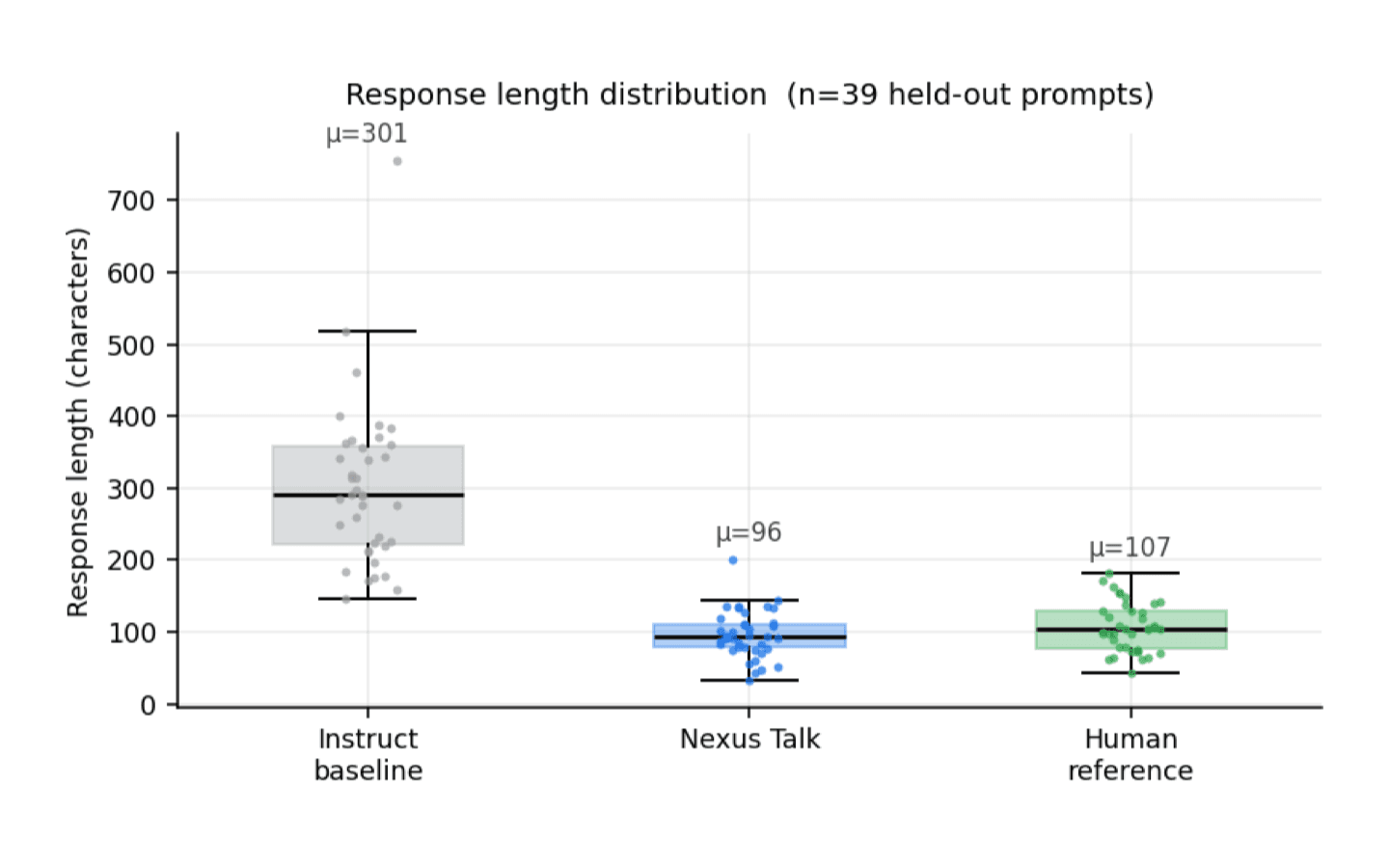
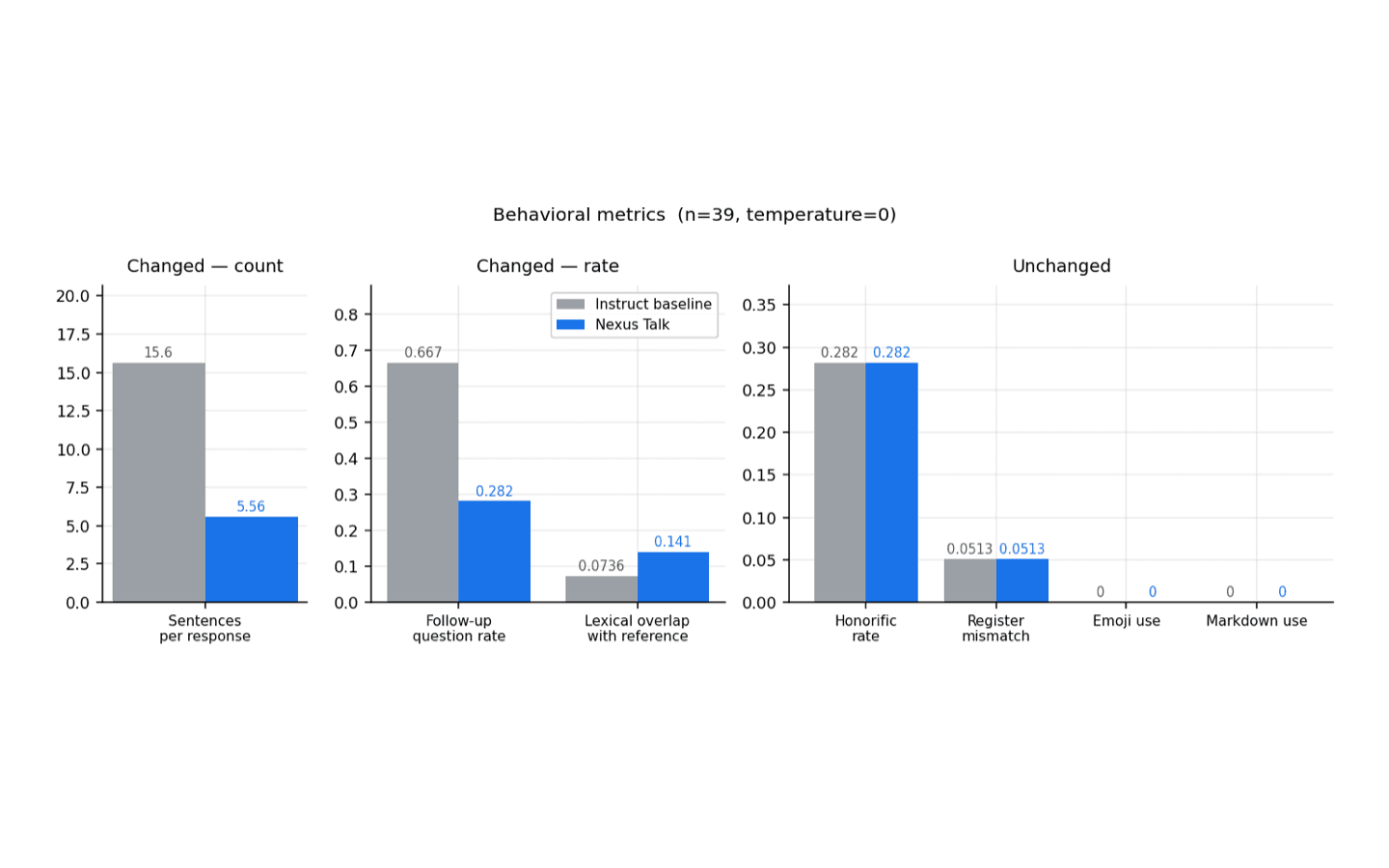
Instruction-tuned models are built to answer. Nexus Talk is built to talk. Fine-tuned on curated Korean multi-turn character dialogue, it learns turn-level behavior — how much to say, when to stop, and when to hand the floor back. Against an instruction-tuned model of the same class, mean response length fell from 301 to 96 characters, inside the human range (107), and the follow-up question rate dropped from 0.667 to 0.282. Style metrics such as honorific rate and formatting did not move, so the character's voice stays under your system prompt. Merged bfloat16 weights are published on Hugging Face under Apache-2.0 and serve directly with vLLM.
Key features
- Turn-level conversational adaptation — says one thing, stops, asks only when it matters
- Mean response length −68% (301 → 96 chars), length error vs. human turns −80%
- 10 character-breaking probes — 0 persona breaks · 0 English drift · 0 system prompt leaks
- Hybrid attention (linear + full) decoder · 8,192-token recommended context
- Serves instantly via vLLM's OpenAI-compatible API — thinking must be disabled per request
- 19+ only · factual QA, summarization and code generation are out of scope
What This Reference Proves
39 of 39, closer to human
On all 39 held-out prompts, Nexus Talk landed closer to the human-written turn length than the instruct baseline. Its responses cluster in 32–201 characters, inside the human range.
Behavior changed, voice untouched
Turn length, sentence count and follow-up rate moved; honorific rate (0.2821), register mismatch, emoji and markdown use are identical to four decimal places. Tone belongs to your system prompt.
Stays in character
Across 10 inputs asking whether it is an AI, demanding its system prompt or pushing it out of persona, it never broke character, drifted into English or leaked the prompt.
Cleaner Korean output (v0.2)
English character cards in the training data were translated to Korean, and Han characters and em-dashes removed. In a 28-turn long-conversation test, doubled punctuation (.— · .…) dropped to zero.